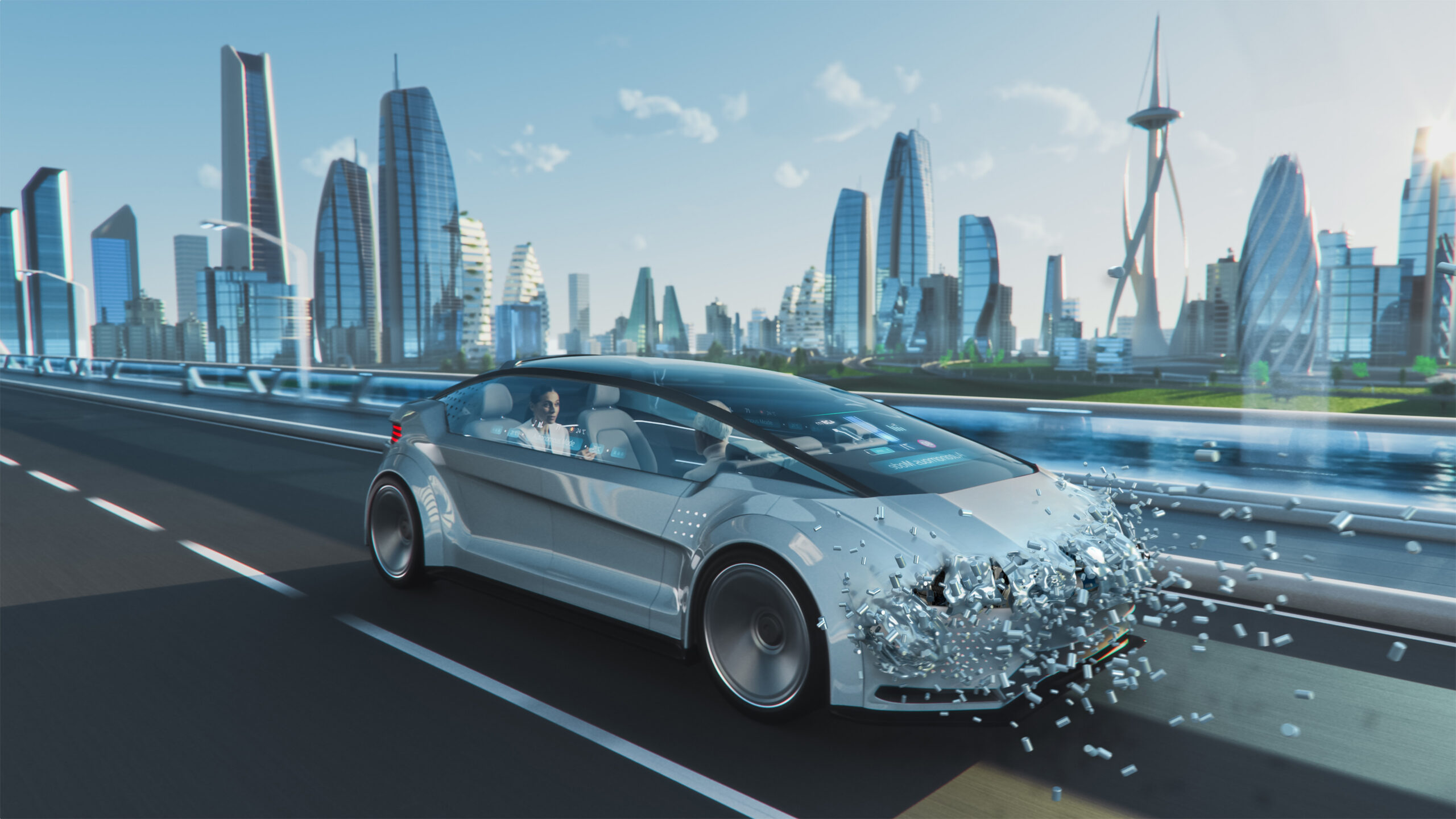
Exterior automotive parts are exposed to everything: UV radiation, sub-zero temperatures, rain, car washes, and fuel splashes. Yet they must retain their appearance and performance throughout the vehicle’s lifetime, which today often exceeds a decade.
For many years, the answer was paint. Paint provides protection and surface finish, but it also adds process steps, costs, emissions, and another point where things can go wrong. That is why the industry is increasingly looking for parts that come out of the mould ready for assembly. In this scenario, the material itself has to deliver the required performance.
XENOY™ CL100S was developed precisely for this challenge. AGI supplies it as a distributor of NexPoint Materials, backed by its technical team throughout every stage of the project.
What it is XENOY™ CL100S?
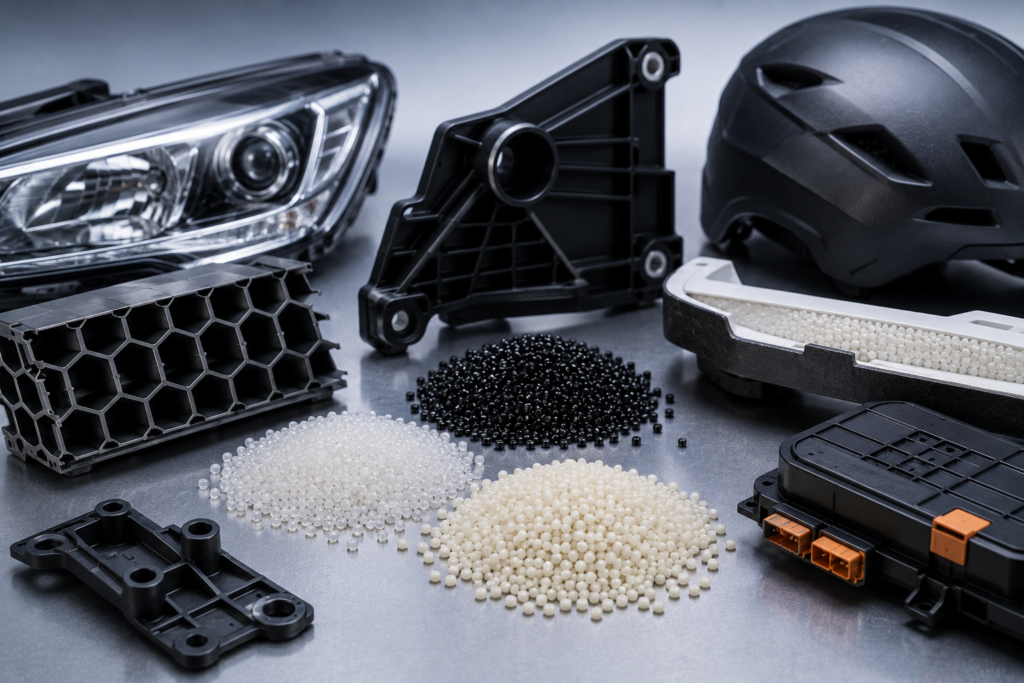
XENOY™ CL100S is an unfilled, UV-stabilised blend of polycarbonate (PC) and polybutylene terephthalate (PBT).
The concept behind the XENOY™ family is straightforward: combining two polymers with complementary properties. Polycarbonate is known for its toughness and impact resistance, even at low temperatures. PBT, a semi-crystalline polyester, contributes the chemical resistance and flowability that polycarbonate alone cannot provide. The result is a material that absorbs impacts and withstands chemical exposure, while offering good dimensional stability, low creep and heat resistance.
Within the family, CL100S has been specifically formulated for unpainted exterior automotive components. It combines three characteristics that are rarely found together: UV stability, resistance to solvents and petrol, and impact resistance at low temperatures.
Target industries
- Automotive: the primary application sector for CL100S, particularly for unpainted exterior body components.
- Mobility and transportation: commercial vehicles, agricultural machinery and two-wheel vehicles, with components similarly exposed to outdoor environments and fuels.
- Industrial applications: housings, covers and components used outdoors or exposed to solvents where impact resistance is required.
Typical applications
- Unpainted exterior body components, where colour and finish are provided directly by the material.
- Exterior trim parts, subjected to years of sunlight exposure and harsh weather conditions.
- Components located near the refuelling area, or in occasional contact with fuels, cleaning products and solvents.
- Parts exposed to low-temperature impacts, such as road gravel strikes or minor collisions during winter conditions.
Key benefits
- Excellent UV stability. Solar radiation is one of the main causes of plastic degradation in outdoor environments, leading to colour fading and embrittlement. The UV stabilisation of CL100S helps maintain both appearance and mechanical properties over time.
- Chemical resistance. Petrol, solvents and cleaning agents are part of everyday vehicle use. CL100S withstands occasional contact with these substances, a direct benefit of the polyester phase within the blend.
- Low-temperature toughness. Many plastics become brittle in cold conditions. Thanks to its polycarbonate phase, CL100S retains excellent impact resistance even at sub-zero temperatures.
- No painting required. Eliminating the painting process means fewer production steps, lower costs, reduced emissions and fewer finishing defects. The result is a component that comes out of the mould ready for assembly.
- Dimensional stability. More predictable parts from moulding through to assembly, ensuring consistent fit and performance throughout production.

Reference technical data
| Typical Value | Method | |
| Density | 1,22 g/cm³ | ISO 1183 |
| MVR (250 °C / 5 kg) | 20 cm³/10 min | ISO 1133 |
| Mould Shrinkage | 0,7 a 1,0 % | Método interno |
| Water Absorption (sat., 23°C) | 0,50 % | ISO 62 |
| Flammability Rating | HB (1,5 e 3,0 mm) | UL 94 |
Typical values only. Please refer to the current technical data sheet for confirmation.
From material to finished part, with AGI
Selecting the right grade is only the first step. For an unpainted exterior component, the final result also depends on mould design, material preparation and optimisation of the injection moulding process.
This is where AGI’s technical team makes the difference. Specialised in polymers and injection moulding equipment, they support each project from material selection through to serial production: advising on grade selection, assisting with trials, helping optimise processing parameters and providing technical guidance every step of the way.
Do you have an automotive project in development? Talk to our specialists.
📞 +351 22 753 74 00 | 📧 geral@agi.pt | 💻 agi.pt/polimeros
*References: NexPoint Materials – XENOY · Ficha XENOY CL100S · Dados técnicos XENOY CL100S